Hannah Doll
The Zone of InterestHannah Doll is the wife of Paul Doll, the camp Commandant, and a central figure in the novel’s intimate conflicts. Seen chiefly through Angelus Thomsen’s and Paul Doll’s accounts, she is at once withdrawn from public life, frank in moments of confrontation, and connected to a past that neither husband nor admirer can simply define for her. Her refusal of Thomsen’s proposal, her disclosure that she gave Paul his black eyes, and her quiet declaration that the war is lost each puncture the assumptions made about her.
Identity and Background
Hannah’s first appearance is framed by Thomsen as a sudden emotional event: speaking to his lifelong friend Boris Eltz, he recalls feeling young again and compares the moment to love. The framing establishes the intensity of his response, but it does not establish Hannah’s feelings in return. She is named as Mrs Hannah Doll, and her position as the Commandant’s wife shapes the social and domestic limits through which other characters encounter her.
Her earlier life complicates that title. In 1928, she enrolled at the University of Rosenheim in southern Bavaria to study French and English. She and two friends attended lectures by Dieter Kruger, who taught Marx and Engels; the initial attraction was his good looks. When Kruger asked whether she felt passionately about the Communist cause, she said that she did, although the account explicitly describes this answer as untrue. He then invited her to weekly meetings of the group he chaired in the back room of a downtown café. Kruger was not only an academic but an activist and street fighter, and his political group was caught up in armed conflict with right-wing factions. Hannah and Kruger began an affair and lived together, more or less. In this recollection, her political involvement begins not as a stated conviction but as a route into a relationship whose attraction and risks the narrative places side by side.
Life in the Commandant’s Household
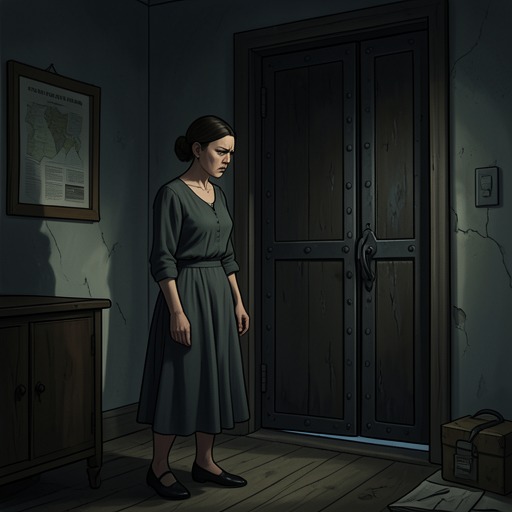
The account of Hannah’s routine is carefully qualified: as far as Thomsen can determine, she takes her daughters to school and brings them home, but otherwise hardly leaves the house. She does not attend either of the experimental dances, the cocktail party in the Political Department, or the gala screening of the romantic comedy Two Happy People. Paul attends each event. His recurring expression is described as that of a man mastering wounded pride; his lips purse as though he might whistle, then settle into a beak-like shape. The repeated contrast is telling: his public appearances make her absence visible, while the narrator can report little about what she does beyond the household’s daily circuit.
A later garden scene offers a more particular image. After the girls have been put to bed, Thomsen finds Hannah beside the picnic table, wearing a white shawl, with a glass of red wine and a Davidoff cigarette. Against the salmon-coloured sunset and rolling clouds, she is asked to take the three of them to her mother’s for a week or two. Her immediate question is where Bohdan Szozeck is. The exchange gives her concern a concrete object, even as the brief scene leaves its circumstances unexplained; she is not merely the recipient of Thomsen’s advice but the person who redirects the conversation to someone absent.
Desire, Refusal, and Self-Possession
Thomsen’s first-sight response leads him to assume that Hannah could not care for someone like her husband. He acts on that assumption by proposing that they meet without Paul’s knowledge and asking whether she would consider it. Hannah refuses. She calls the suggestion reckless and tells Thomsen that he does not understand, even if he thinks he does. Rather than answer his desire with a reciprocal confession, she identifies the limit of his understanding and steps back. Her response makes the scene a test of Thomsen’s confidence: he has mistaken his impression of her marriage for knowledge of her wishes.
Her later exchanges with Paul also resist easy interpretation. When Paul’s conversation implies that Bohdan gave him his black eyes, Hannah corrects him: Bohdan did not; she did. The admission is brief and direct, overturning the assumption about the injury without explaining the circumstances or her motive. In another exchange, Paul begins to tease her about knowing something she does not know. Hannah identifies Angelus Thomsen as the subject before he can finish. She then says that she has no reason to see him again, recalls that he was polite but resented anything that interrupted his mission, and says she was sorry to have imposed on him. The scene holds her knowledge and denial together: she recognizes the subject immediately, but the available account does not establish what she intends to do next.
Memory, War, and Judgment
A Tuesday garden episode renders Hannah at a distance. At four o’clock she comes through the breakfast-room glass doors, walks around the garden for five minutes beneath an umbrella, and wears a hoodless duffel coat. Thomsen is in the building where uniforms, boots, and belts are kept; he says she does not look in the direction where she knows he is. The careful arrangement of time, clothing, and sightline turns a small walk into an encounter defined by non-contact. It contrasts with his earlier account of first sight and his later proposal: attraction does not give him access to her attention.
Hannah’s clearest political judgment emerges in an exchange with Paul. He tells her that Kruger is dead and asks why she looks so radiant. She answers that the war is lost. Paul treats her response as a crime and invokes the supreme penalty. Her gladness is therefore more than a private mood within the marriage: it directly contradicts the Commandant’s loyalty and turns his language of punishment against his own wife. The contrast is sharpened by Paul’s other efforts to present himself as a normal man and to justify his actions through loyalty to Germany. Here, however, Hannah’s answer is plain, and his threat exposes the violence beneath his claim to moral authority.
Narrative Role
Hannah’s characterization depends on the difference between what the men see and what they can know. Thomsen turns first sight into a story of renewed youth, then discovers that desire does not make his reading of her reliable. Paul registers her absences as injuries to his pride, yet the domestic routine he observes gives little access to her inner life. Hannah’s refusals, corrections, and judgments interrupt those male accounts without supplying a complete alternative history. The result is not a portrait of simple passivity: she remains constrained by her place in the Commandant’s household, but she speaks decisively at the moments when other characters presume to explain her.